
As 2026 unfolds, we’re witnessing a transformation in the workplace that is both profound and inevitable. As a business leader, founder, or practitioner navigating these changes, you need to understand this: digital coworkers, or AI employees, are no longer just futuristic concepts or productivity curiosities. They are real collaborators, ready to amplify human potential in ways we are only beginning to grasp.
If you have been hesitant or skeptical about AI’s role in your organization, 2026 demands a fresh perspective. The companies that treat AI as a mere tool will be outpaced by those embracing it as a teammate. Let’s explore what this means and how to make it a strategic advantage rather than a disruptive threat.
The Evolution of AI Employees: From Skepticism to Seamless Partnership
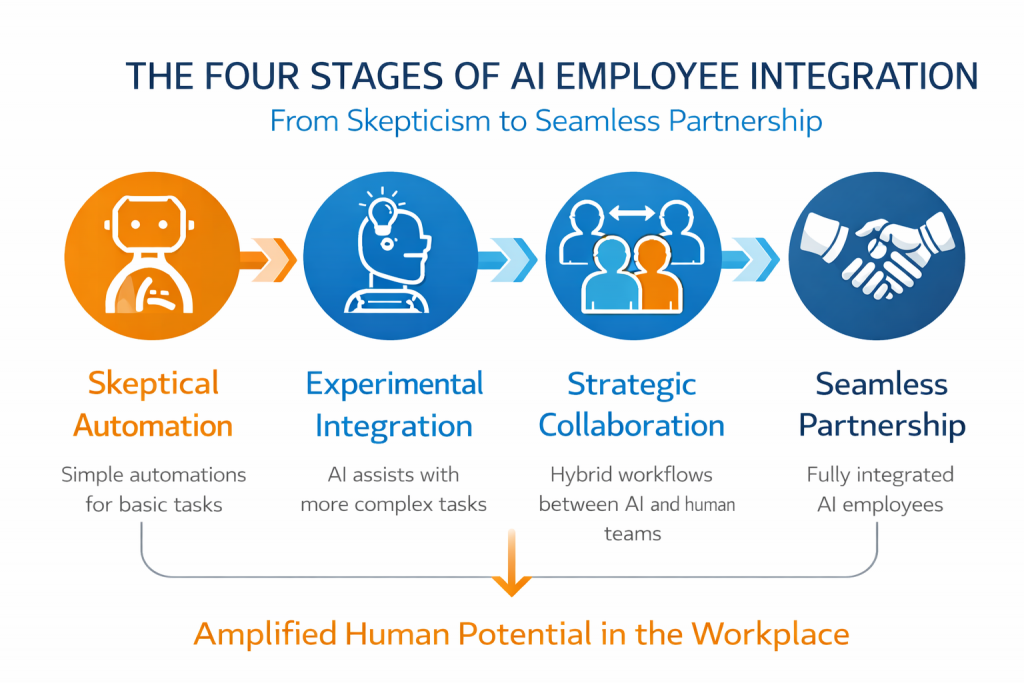
I’ve observed a clear pattern in how organizations integrate AI employees, which I break down into four stages:
- Skeptical Automation
Initially, many companies dipped toes into AI with simple automations chatbots managing FAQs, or scheduling tools helping with calendars. At this stage, AI was a tool to handle tasks, nothing more.
- Experimental Integration
Then pioneers began leveraging AI for more complex work. Marketing drafts, lead qualification, content generation these weren’t just time savers but hints at a new way to work.
- Strategic Collaboration
This phase is where mindset shifts radically. AI stops being a threat and becomes a partner. Human creativity and judgment collaborate with AI’s data processing aptitude. Teams design hybrid workflows where AI handles the heavy data lifting while people focus on relationships, strategy, and creativity.
- Seamless Partnership
The future is here for the most advanced companies. AI employees are fully integrated members of the team, with defined roles, access privileges, and respected collaborations. The boundary between tasks “for AI” and “for humans” becomes fluid and strategic.
Navigating this progression requires more than technology. It demands fostering a culture of trust and reimagining how work gets done.
Why This Is a Psychological, Not Just Technical, Shift
Resistance to AI employees is less about capability and more about fear. The software that once seemed benign suddenly assumes a proactive role. Managers who welcomed tools now feel threatened when those tools show autonomy.
From my vantage point, the key to successful adoption is reframing AI’s purpose: AI takes on tasks, not jobs. This change in language matters profoundly. When a social media manager partners with an AI that suggests ideas, schedules posts, and analyzes engagement, the manager isn’t replaced they’re elevated to craft brand voice and community engagement.
This human-AI collaboration creates augmented teams where human intuition joins AI’s scale to produce unrivaled results. Those who master this will unlock engagement, faster adoption, and higher performance.
Practical Examples: How Digital Coworkers Boost Productivity Across Functions
Organizations already using AI employees see tangible time savings and impact. Think of an AI executive assistant managing your inbox and calendar, freeing 25 to 30 hours a month. Or a social media AI manager creating content and analyzing engagement, saving 20 to 25 hours monthly. Salespeople benefit from AI lead qualification automation, improving conversion rates.
In a field study at a major consulting firm, consultants using AI completed more tasks faster and with higher quality than their peers. This isn’t about replacement, it’s about strategic delegation, maximizing each resource’s strengths.
Preparing Your Organization: What to Do Now Versus Later
This journey starts now. The advantage lies with organizations who proactively prepare for AI employee integration:
Technical Preparation must include auditing existing tech stacks for AI compatibility, establishing security and access controls, and developing performance tracking mechanisms tailored for AI roles.
Team Preparation involves raising AI literacy, identifying internal champions, crafting hybrid workflows, and establishing clear communication protocols for interacting with AI colleagues.
Strategic Planning means clearly defining AI roles and responsibilities within your workforce architecture, setting quality control measures, and planning for continuous learning and adjustment as AI evolves.
Those who do this in 2026 will be ahead of the curve. Those who wait will struggle with piecemeal automation while competitors enjoy cohesive AI-human symbiosis.
Going Beyond Basic Integration: Advanced AI Strategies for 2026
Looking beyond initial adoption, I urge leaders to consider deeper AI strategies. Imagine cross-functional AI teams collaborating internally to ensure message consistency and operational coherence. Implement continuous learning loops so AI systems evolve from feedback, not just initial programming.
Develop decision frameworks that specify how and when tasks shift between AI and humans, ensuring neither over-reliance nor under-utilization of AI capabilities. And crucially, track AI performance with the same rigor as human employees not just for efficiency, but for quality, creativity, and impact.
The Biggest Predictor of Success in 2026? Adaptability
It turns out adaptability not perfection in AI implementation will separate the leaders from the laggards. It won’t be about having the flashiest AI but about how fluid and intentional your organization’s human-AI partnership becomes.
As the workplace transforms, expect more roles to redefine themselves, more managers to lean on AI augmentation, and new collaborative cultures to emerge. Preparing today means positioning your people and technology to learn and evolve together.
Wrapping Up
In summary, 2026 is the year digital coworkers move beyond novelty into indispensability. They aren’t here to replace us; they are here to amplify what makes us uniquely human creativity, judgment, empathy, and strategic insight.
If you want your organization to thrive, start now. Audit your technical readiness, cultivate AI literacy and trust in your teams, and design strategic partnerships between humans and AI. Be intentional about measuring outcomes and adapt as the technology and culture evolve.
Your new digital coworkers are ready to introduce themselves. The only question is: are you ready to work alongside them to amplify your organization’s potential beyond what was previously imaginable? The future’s not waiting, your partnership with AI begins today.
* Disclosure: The image is an AI-generated rendering